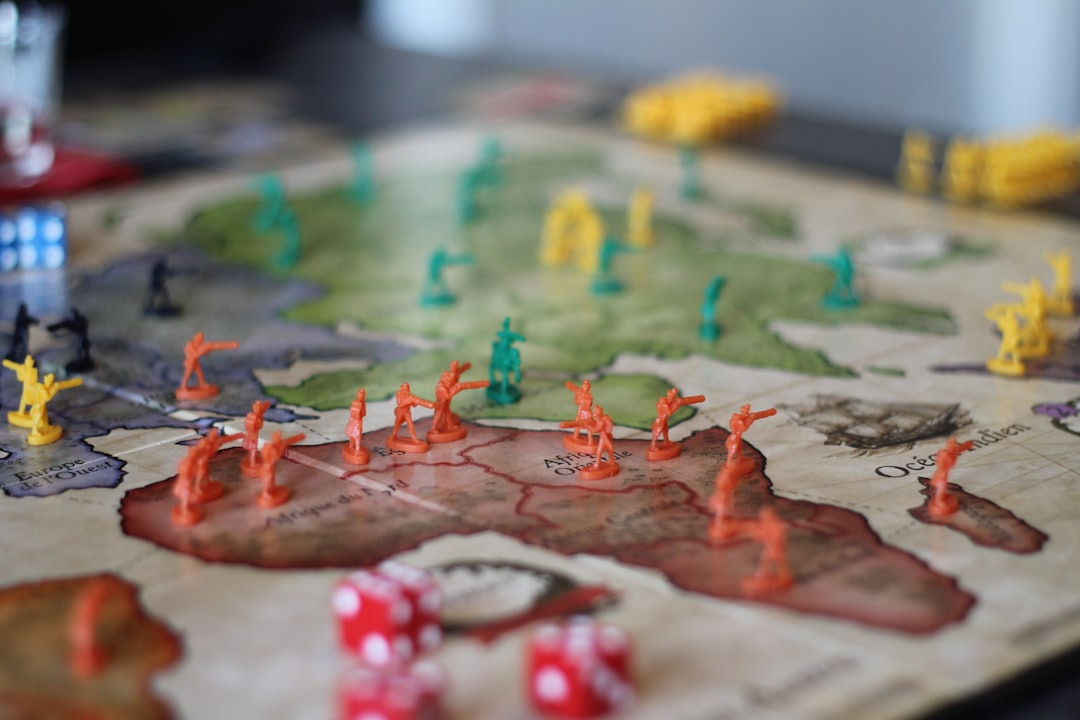
You’ve unboxed the game, read the rules, and set up the board. Yet, midway through, you find yourself outmaneuvered, your plans crumbling as an opponent executes a brilliant, unforeseen move. This is the core challenge and thrill of strategy board games. They are not tests of luck, but of foresight, planning, and adaptation. This guide is your tactical playbook, designed to equip you with a universal framework to deconstruct, analyze, and ultimately dominate any strategy game you place on the table.
The Universal Objective in Strategy Board Games: Understanding Win Conditions
Before you can formulate a winning plan, you must have a crystal-clear understanding of the finish line. Every action you take must be a step toward the game’s defined victory condition. “Winning” is rarely as simple as just eliminating other players; it’s about mastering the specific scoring system the game presents.
Most strategy board games define victory in one of a few key ways. Your first step is to identify which archetype the game uses and internalize it. Don’t just read the “How to Win” section of the rulebook—obsess over it.
- Victory Point (VP) Engines: In these games (often called “Eurogames”), players are competing to build the most efficient system for generating points over time. The winner is simply the player with the highest score when the game ends. Your entire focus should be on VP optimization.
- Area Control / Domination: Victory is achieved by controlling specific territories on the board at key moments or at the end of the game. Your strategy must revolve around tactical positioning, expansion, and defense.
- Objective Fulfillment: Players win by completing a series of public or secret objectives. The key here is efficiency and misdirection; you need to achieve your goals while deducing and potentially blocking your opponents’ objectives.
- Last Player Standing: Common in conflict-heavy games, the objective is direct elimination. Every move should be weighed against how it strengthens your position while weakening others, pushing them closer to being knocked out.
–
–
–
Preparation: Your Pre-Game Tactical Briefing
Victory is often decided before the first piece is moved. A thorough pre-game analysis gives you a decisive edge. This is your reconnaissance phase, where you arm yourself with the knowledge needed to build a robust and adaptable strategy.
Deconstructing the Rulebook: Beyond the Basics
Reading the rules is not the same as understanding the game’s systems. Your goal is to identify the core “levers” you can pull to gain an advantage. During your rules analysis, actively search for the answers to these critical questions:
- Resource Scarcity: What is the most limited resource in the game? Is it actions per turn, a specific type of currency, or unique cards? Controlling or efficiently using the scarcest resource is often the key to victory.
- Action Economy: How many actions do you get per turn or per round? The player who can generate the most value out of their limited actions will almost always win. Look for moves that provide multiple benefits or allow you to take extra actions.
- Core Game Loop: What is the fundamental cycle of play? Is it Draft a card -> Play a card -> Gain resources? Or is it Move unit -> Attack unit -> Consolidate position? Master this loop so you can perform it more efficiently than anyone else.
- Game-End Triggers: How does the game actually end? Is it after a fixed number of rounds, when a specific resource pile is depleted, or when a player reaches a VP threshold? Knowing this allows you to control the game’s pacing, either accelerating towards the end if you’re ahead or stalling if you need to catch up.
Know Your Faction, Know Your Enemy
Many modern strategy board games feature asymmetric factions or variable player powers. Choosing a faction at random or based on the coolest-looking miniatures is a rookie mistake. Take a moment to analyze the strengths and weaknesses of your assigned role and, just as importantly, those of your opponents.
If your civilization gets a bonus for trading, you should prioritize establishing trade routes early. If an opponent’s faction excels at early-game aggression, you need to prepare your defenses from turn one. This initial assessment shapes your opening moves and prevents you from being caught off guard by a predictable strategy.
The Core Strategy: A Universal Playbook for Strategy Board Games
With your preparation complete, it’s time to execute. This three-act structure—Opening, Mid-Game, and Endgame—applies to nearly all strategy board games and provides a framework for your decision-making process.
-
The Opening Gambit: Secure Your Foundation (Turns 1-3)
The first few turns are not about winning the game; they are about not losing it. Your objective here is to build a solid foundation that will support your mid-game strategy. Avoid risky, high-variance plays in favor of consistent, foundational moves.
Focus your efforts on establishing an “engine.” In a resource management game, this means securing a reliable income of wood, stone, or whatever currency the game runs on. In a deck-building game, it means culling your weak starting cards and acquiring more powerful ones. In an area control game, it means claiming a defensible starting position that has access to valuable resources. The “Why”: A strong opening prevents you from playing from behind for the entire game, a position from which it is incredibly difficult to recover.
-
Mastering the Mid-Game: Pivot and Adapt
This is where the board state becomes complex and where games are truly won or lost. Your early-game engine should now be running, and your focus must shift from internal development to external awareness. You must constantly read the board and assess your opponents’ positions.
Who is the current leader? What is their path to victory, and how can you disrupt it? The best strategy to win at a game is rarely a single, rigid plan. It is a series of adjustments and pivots in response to your opponents’ actions. If an opponent is building an unstoppable VP engine, you cannot afford to ignore them and continue building your own lesser engine. You must shift your strategy to interact with and slow them down, even if it comes at a small cost to your own efficiency.
This is also the phase to think about tempo and initiative. Are you reacting to threats, or are you creating threats that force others to react to you? Seizing the initiative forces your opponents to play on your terms, disrupting their plans and giving you control over the flow of the game.
-
The Endgame Countdown: Executing the Victory Push
You must learn to recognize the signs that the game is entering its final phase. A nearly depleted deck of cards, a player approaching the final VP space, or a dwindling number of game rounds are all signals to shift your mindset. Stop building your engine and start cashing it in for points.
Every single action in the endgame must be ruthlessly evaluated for its Victory Point impact. An action that improves your engine is now worthless if the game ends before you can use it. Instead, focus on grabbing last-minute objectives, fulfilling scoring conditions, and making “denial plays.” A denial play is a move that may not grant you many points but prevents an opponent from scoring a massive amount. For example, in Ticket to Ride, this could mean claiming a small, seemingly useless route specifically because you know it blocks an opponent’s 20-point destination ticket. These moves can swing the final score dramatically.
Advanced Tactics for Dominating Strategy Board Games
Once you’ve mastered the fundamental three-act structure, you can begin integrating more advanced concepts into your play. These principles separate skilled players from true masters.
The Art of Action Economy
Consider every action you take as a currency. You are given a finite amount each round, and your goal is to “purchase” the most value possible. The best players instinctively analyze the return on investment for every potential move.
Look for ways to maximize this economy. Can you find a card that lets you perform two actions for the price of one? Is there a board space that provides both a resource and a tactical advantage? Consistently choosing actions that are even 10% more efficient than your opponents’ will create a compounding advantage that becomes insurmountable over the course of a game.
Probability and Risk Management
Many strategy games incorporate elements of luck, such as dice rolls or card draws. Do not be a slave to chance; become a manager of it. Understand the basic probabilities at play. If you need to roll a 7 or higher on two six-sided dice, you should know that you have a 58.3% chance of success. This isn’t just trivia; it’s actionable data.
Use this knowledge to inform your decisions. If your entire game-winning move hinges on a 1 in 36 chance, it’s probably a bad plan. Look for ways to mitigate risk. Can you acquire an item that adds +1 to your roll? Can you pursue an alternative strategy that relies on a more probable outcome? The best players don’t avoid risk; they take calculated risks where the potential reward heavily outweighs the statistical danger.
Psychological Warfare: Reading Your Opponents
Strategy board games are played against people, not robots. Pay attention to your opponents’ tendencies. Does one player always play aggressively? Does another hoard a specific resource before making a big move? This information is a resource in itself.
You can use this to your advantage through bluffing and misdirection. If you start collecting a lot of wood, your opponents may assume you are building a wood-based strategy and try to block you, while your real plan involves stone. By telegraphing a false intention, you can manipulate your opponents into making suboptimal moves that inadvertently help you.
Common Pitfalls and How to Avoid Them
Even with a solid strategy, certain common mistakes can unravel your entire game. Recognizing and actively avoiding these pitfalls is crucial for consistent victory.
- Analysis Paralysis: This is the state of being so overwhelmed by choices that you take an excessive amount of time on your turn, slowing the game to a crawl. The Fix: Timebox your decisions. For minor moves, give yourself 30 seconds. Trust your strategic instincts. It’s better to make a good decision quickly than a perfect decision slowly.
- Playing “Multiplayer Solitaire”: This happens when you become so focused on optimizing your own player board that you completely ignore what your opponents are doing. This is a fatal error, as it allows a runaway leader to go completely unchecked. The Fix: At the start of every one of your turns, dedicate 15 seconds to scanning the board and asking, “Who is winning, and why?”
- The Sunk Cost Fallacy: This is the tendency to continue with a failing strategy simply because you’ve already invested resources into it. The Fix: Be ruthless in your self-assessment. If your plan is not working, abandon it. Cutting your losses and pivoting to a new strategy is a sign of a strong player, not a weak one.
- Misunderstanding the Game’s Arc: Many players continue building their engine for far too long, only to realize the game is ending and they have no time to convert their potential into actual points. The Fix: Always be aware of the game-end triggers. Pace your strategy to peak just before the game concludes, ensuring you are scoring points when they matter most.
FAQ: Mastering Strategy Board Games
- How do I get better at a specific strategy board game I just bought?
-
The fastest way to learn a new game’s intricacies is to remove the pressure of competition. If the game has a solo mode, play it several times. This allows you to experiment with different strategies and see how the game’s systems interact without being punished for mistakes.
Next, consume community content. Watch “how to play” and strategy videos from experienced players. Read forums like BoardGameGeek for discussions on common opening moves, faction-specific advice, and powerful card combos. The goal is to internalize the game’s core loop and strategic landscape before you try to outwit human opponents.
- What is the single most important skill for winning strategy board games?
-
Adaptability. Without question, the most critical skill is the ability to pivot. No single strategy will survive first contact with your opponents. You can have the most brilliant opening plan, but if another player’s actions render it ineffective, you must be willing and able to change course.
The best strategy to win at a game is almost never a static, pre-written script. It is a fluid and dynamic response to the constantly evolving board state. The best players build a solid foundation and then constantly re-evaluate their path to victory based on new information and opponent actions.
- Are “Eurogames” and “Ameritrash” games different strategically?
-
Yes, the strategic demands are significantly different. Eurogames (e.g., Catan, Agricola, Terraforming Mars) typically feature low direct conflict, minimal luck, and a strong focus on resource management and engine-building. The strategic challenge is primarily about optimization and efficiency—who can build the best VP-generating machine?
Conversely, “Ameritrash” or thematic games (e.g., Twilight Imperium, Zombicide, War of the Ring) embrace direct conflict, higher levels of randomness (dice), and strong narratives. Strategy in these games requires aggressive risk-taking, tactical positioning for combat, and the ability to capitalize on sudden opportunities created by luck.
- How do I balance building my economy versus attacking my opponents?
-
This is the central tension in most interactive strategy games. A useful concept to apply here is “Tempo.” In the early game, your priority should almost always be building your own engine or economy. You cannot attack effectively from a weak position.
As you enter the mid-game, you must evaluate the board. If you are ahead, you can afford to continue building your lead while playing defensively. However, if another player is pulling away, you must shift to a more aggressive, disruptive strategy. Your goal is not to have the most impressive engine at the end of the game; your goal is to have the most points. Sometimes, that means slowing an opponent down even if it’s slightly less efficient for you in the short term.
Winning at strategy board games is not a matter of chance. It is the result of a deliberate, analytical process: understanding the objective, preparing meticulously, and executing a flexible, three-act plan. By internalizing this framework and avoiding common pitfalls, you transform yourself from a mere participant into a formidable opponent. You now have the playbook. Go execute.
Be sure to comment below if this article helped you!
Leave a Reply